
Introduction
Japan is often described as one of the safest, cleanest, and most organized countries in the world.
But if you’re visiting Japan for the first time, you might also notice something interesting:
There are a lot of unwritten rules.
Nobody will hand you a rulebook when you arrive at the airport, and in most cases, Japanese people probably won’t say anything even if you accidentally break one.
That doesn’t necessarily mean they don’t notice, though.
The good news is that you don’t need to understand every detail of Japanese etiquette to enjoy your trip.
Most Japanese people understand that foreign tourists aren’t familiar with every Japanese custom.
Still, knowing a few basic rules can make your trip much easier — and help you avoid accidentally annoying the people around you.
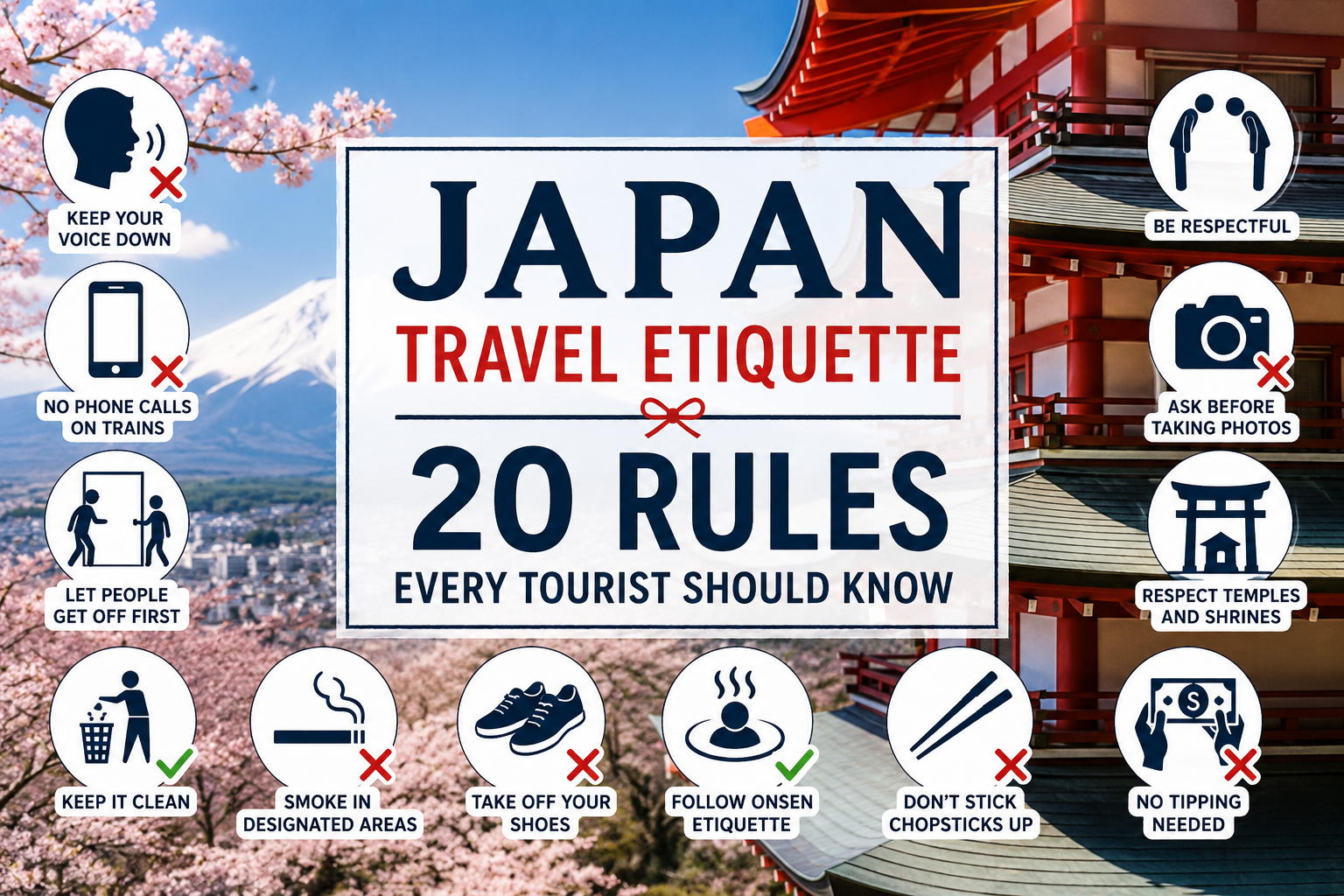
As a Japanese person living in Japan and working at a bar where I regularly meet travelers from around the world, these are 20 things I think every tourist should know before visiting Japan.
1. Don’t Talk Loudly on Trains
Japanese trains are usually surprisingly quiet.
People talk to their friends, of course, but conversations tend to be relatively quiet.
What stands out much more is someone speaking loudly across the train.
You don’t have to remain completely silent.
Just keep your voice at a reasonable level.
This is especially important on commuter trains in cities such as Tokyo, Osaka, and Kyoto.
2. Avoid Phone Calls on Trains
Talking with someone next to you is generally fine.
Talking loudly on the phone is different.
You’ll often see Japanese passengers reject calls and send a message instead.
If someone calls you while you’re on a train, the easiest option is:
Wait until you get off the train and call them back.
3. Let People Get Off the Train First
When a train arrives, don’t immediately walk inside.
Stand beside the doors and let passengers exit first.
Once everyone has gotten off, you can board.
You’ll see people naturally form lines around the platform markings.
Following those lines makes everything much easier.
4. Don’t Block Escalators or Busy Walkways
Japan’s major train stations can be extremely crowded.
Tokyo Station, Shinjuku Station, Shibuya Station, Osaka Station, and Kyoto Station can feel overwhelming if you’re visiting for the first time.
If you suddenly stop in the middle of a busy walkway to check Google Maps, people behind you may have nowhere to go.
If you’re lost — which happens to everyone — move to the side first and then check your phone.
One extra note about escalators:
You may notice people standing on one side and walking on the other, and the side varies by region.
However, railway operators increasingly encourage passengers to stand rather than walk on escalators, so you don’t need to memorize a strict “Tokyo side” or “Osaka side” rule.
5. Queue Properly
Japan loves lines.
Train platforms.
Restaurants.
Convenience stores.
Theme parks.
Buses.
If there’s a line, go to the back of it.
At train stations, markings on the ground usually show exactly where passengers should wait.
Cutting into a queue is one of the easiest ways to annoy people anywhere in the world, and Japan is no exception.
6. Don’t Eat While Walking in Crowded Places
This one is sometimes exaggerated online.
Eating while walking is not illegal, and it’s not universally considered offensive.
But traditionally, Japanese people often prefer to stop somewhere before eating.
This is especially sensible in crowded areas because you don’t want to bump into someone while holding hot or messy food.
At food markets, festivals, or street-food areas, there may be designated spaces nearby where you can eat.
When in doubt, buy your food, step aside, and enjoy it there.
7. Don’t Litter — Even Though Trash Cans Are Rare
One thing surprises many tourists:
Japan is extremely clean, but public trash cans can be surprisingly difficult to find.
So what do Japanese people do?
Often, we simply carry our trash until we find somewhere appropriate to dispose of it.
Convenience stores, stations, vending-machine areas, and shopping facilities sometimes have bins, although availability varies.
If you can’t find one, keep your trash with you instead of leaving it somewhere.
Carrying a small plastic bag in your backpack can be surprisingly useful.
8. Don’t Smoke Wherever You Want
Smoking rules in Japan have changed significantly.
In many cities, smoking while walking or smoking on the street outside designated areas is prohibited or restricted.
Instead, you’ll find designated smoking areas in certain stations, shopping centers, entertainment districts, restaurants, and other facilities.
If you smoke, look for signs showing where smoking is allowed.
Don’t assume that being outdoors automatically means you can smoke there.
9. Take Your Shoes Off When Required
You’ve probably heard this one already.
Japanese people often remove their shoes before entering certain indoor spaces.
This includes many:
- Homes
- Traditional ryokan
- Temples
- Tatami rooms
- Some restaurants
- Certain accommodations
The easiest clue is a genkan, the lowered entrance area where shoes are left.
You may also see slippers waiting for you.
If you’re unsure, look at what other people are doing or simply ask.
10. Never Step on Tatami With Outdoor Shoes
Tatami mats require a little extra attention.
Never walk onto tatami while wearing outdoor shoes.
Usually, you should remove your shoes before entering the room.
In many traditional settings, slippers are also removed before stepping onto tatami.
Socks or bare feet are normally fine.
11. Learn Basic Onsen Etiquette Before Entering
Japanese hot springs are amazing.
But they also have rules that can surprise first-time visitors.
The most important ones are:
- Wash your body before entering the bath
- Don’t wear a swimsuit unless the facility specifically allows it
- Don’t put your large bath towel into the water
- Don’t swim in the bath
- Keep long hair out of the water
- Respect the quiet atmosphere
Tattoos are another issue.
Some onsen accept tattoos, some allow them if covered, and others still prohibit them.
Always check the facility’s tattoo policy before visiting.
12. Don’t Stick Chopsticks Upright in Rice
This is one of the Japanese table manners worth remembering.
Don’t stick your chopsticks vertically into a bowl of rice.
This resembles a practice associated with Japanese funeral rituals.
Simply place your chopsticks on the chopstick rest or beside your dish instead.
13. Don’t Pass Food From Chopsticks to Chopsticks
Another funeral-related custom.
After cremation in Japan, bones are traditionally handled using chopsticks.
Because of that association, passing food directly from your chopsticks to another person’s chopsticks should be avoided.
If you want to share food, place it onto their plate instead.
14. Slurping Noodles Is Okay
Here’s a rule that’s actually the opposite of what some visitors expect.
Slurping ramen, soba, or udon is generally acceptable in Japan.
You don’t have to do it.
Nobody expects tourists to suddenly become professional noodle slurpers.
But if the person next to you is making a lot of noise while eating ramen, they’re probably not being rude.
They’re just eating ramen.
15. You Usually Don’t Need to Tip
Japan does not have the same tipping culture as countries such as the United States.
At restaurants, bars, hotels, and taxis, you generally don’t need to leave a tip.
Excellent service doesn’t mean the staff is waiting for an additional 15 or 20%.
Simply pay the amount you’re charged.
There are a few specialized situations where gratuities may exist, but for an ordinary trip around Japan:
No tip is necessary.
16. Learn How to Pay at Restaurants
Payment systems vary more than tourists sometimes expect.
At one restaurant, you’ll pay at the table.
At another, you’ll take your bill to the register near the entrance.
At a ramen shop, you might buy a meal ticket from a vending machine before you even sit down.
Cashless payment has become much more common in Japan, but some smaller restaurants and bars still accept cash only.
So I recommend carrying at least some Japanese yen.
17. Don’t Assume Every Restaurant Can Handle Large Groups
This is especially important if you’re traveling with several friends.
Many Japanese restaurants are tiny.
A great local izakaya might have only:
6 seats.
Or 10.
Or one small counter.
Walking into a tiny restaurant with eight people and expecting everyone to sit together may simply be impossible.
For larger groups, make a reservation whenever possible.
18. Respect Temples and Shrines
Temples and shrines are beautiful tourist attractions.
But remember:
They are also religious places.
You don’t need to understand every religious custom before visiting.
Just behave respectfully.
Avoid shouting, climbing on structures, entering restricted areas, or doing anything solely for a funny photo if it disrupts other visitors or worshippers.
Photography may also be prohibited in certain areas.
If you see a No Photography sign, respect it.
19. Ask Before Taking Close-Up Photos of People
Japan is incredibly photogenic.
Traditional streets, izakaya, markets, festivals, temples — you’ll probably take hundreds of photos.
But there is a difference between photographing a street scene and putting your camera directly in someone’s face.
If a person is clearly the main subject of your photograph, asking first is the respectful thing to do.
This is especially important with restaurant staff, craftspeople, performers, geisha or maiko, and ordinary people going about their daily lives.
A simple:
“Photo OK?”
with a friendly gesture will often communicate what you mean.
20. Don’t Worry About Being Perfect
This might actually be the most important rule on this list.
You are a tourist.
Nobody realistically expects you to understand every unwritten rule in Japanese society.
Even Japanese people disagree about certain manners.
If you make a small mistake, don’t panic.
Say:
“Sumimasen.”
It can mean “excuse me” or “sorry” depending on the situation.
Then move on.
What matters most isn’t memorizing hundreds of Japanese rules.
It’s simply being considerate of the people around you.
Final Thoughts
Japan has many customs that can seem complicated from the outside.
But most of them come down to a very simple idea:
Try not to inconvenience the people around you.
Keep your voice down on public transportation.
Wait your turn.
Keep public spaces clean.
Respect religious places.
Follow the rules of restaurants, hotels, and onsen.
And don’t worry too much if you accidentally get something wrong.
Japanese people know that visitors come from different cultures.
Learning even a few basic rules before your trip already makes a difference.
Enjoy Japan, try new things, talk to local people, eat as much Japanese food as possible — and don’t spend your entire vacation worrying about whether you’re holding your chopsticks perfectly.
Respect goes much further than perfection.